







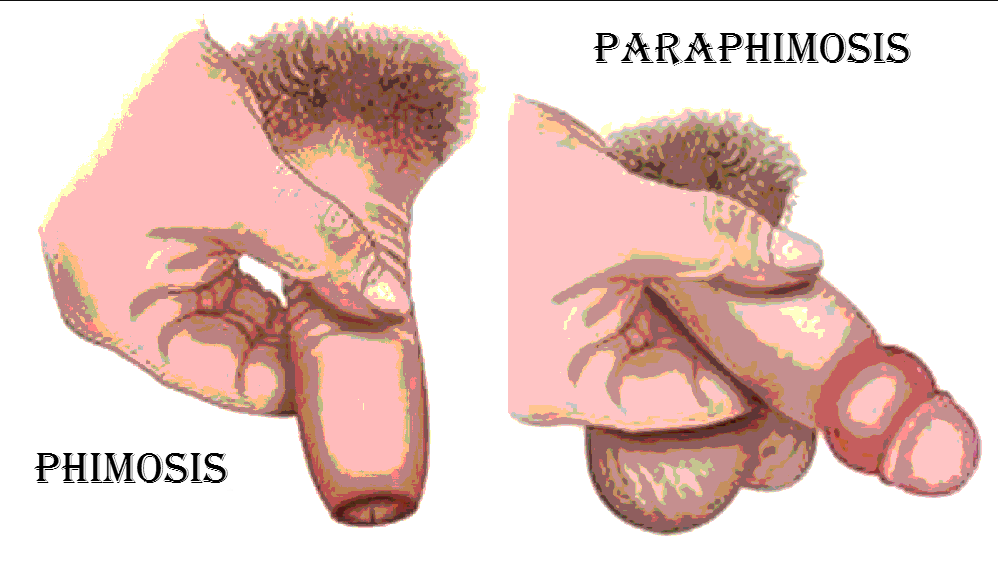
Phimosis is a narrowing of the opening of the preputial sac of the penis, which makes it impossible to expose the head of the male genital organ.

It is physiological in childhood (up to 5-6 years), but for adult boys and men, it is always a pathology.
Translated from Greek, phimosis means tightening, muzzle, and this term quite accurately characterizes the essence of the pathology.
The opening of the preputial sac (it is formed by the leaves of the foreskin) takes the form of a dense, inelastic ring, the diameter of which does not pass the head of the penis.
Pathology causes trouble at any age: the risk of balanoposthitis increases in children. For adult men, the disease creates serious obstacles in their intimate life. However, urology knows how to correct the situation: in most cases, a simple outpatient procedure is sufficient. Sometimes it is necessary to carry out surgical treatment of phimosis, circumcision (circumcision).
Reasons
Almost 96% of newborn boys are born with phimosis. This is a physiological state by which nature tries to protect the penis from external influences, from hypothermia. Normally, by 3–6 years, the opening of the preputial sac expands without treatment. The condition is considered pathological after 6 years, and when it is present in a teenager, an adult man.
Common causes of pathological phimosis:
-
congenital stenosis of the preputial sac;
-
infections of the genital organs, including venereal ones;
-
systemic diseases (scleroderma);
-
groin injuries and burns.
These factors lead to the formation of hypertrophic, atrophic, or cicatricial phimosis. In the first case, the foreskin is massive and looks like a proboscis. In the second, the leaves of the preputial sac are thin, dense. Cicatricial phimosis is manifested when you try to move the skin fold from the penis back: a ring of dense fibrous tissue with white stripes is formed, which prevents the glans from being exposed.
Symptoms
Pathology manifestations depend on its severity.

There are four degrees of phimosis in total:
-
The first degree is easy, it is often missed in children. At the first stage, the head can be exposed, but as soon as the penis fills with blood at least a little, pain occurs.
-
The second degree creates difficulties even at rest. In the 2nd degree, the skin fold shifts, but does not shift completely to the coronal furrow. An erection is accompanied by noticeable pain.
-
The third degree does not allow the penis to be exposed by almost a centimeter, even at rest. External signs of the 3rd degree of the disease are already difficult not to notice.
-
The fourth degree makes erection almost impossible, negatively affects vital activities. With the 4th degree, the entire head is hidden under the foreskin. Plus, the release of urine is disturbed: it accumulates in the cavity of the preputial sac, urination is a sluggish uneven stream without pressure or drops.
We recommend all patients with suspicion of phimosis not to engage in treatment at home or on advice from the network, and not to let the problem go by itself. Apply yourself or show your child to a urologist. A Universum clinic specialist will examine the patient, determine the severity of the pathology and suggest the optimal method of treatment. Consultation is available in Kyiv, Chernivtsi, Khmelnytskyi, Lviv and Uzhgorod, wherever there are branches of the clinic.
Diagnostics
Here everything is decided by the qualification and experience of the doctor: to detect stage 1 or 2 phimosis, a thorough interview of the patient or his parents is necessary. A medical examination is also required.

As a rule, special instrumental and laboratory methods are not required. In some cases, it may be necessary to perform tests for autoimmune diseases, bacteriological tests for suspected genital infections.
Based on the results of the examination and examination, the doctor of the clinic will select the most suitable method of treatment, taking into account the age of the patient, the cause and severity of the process.
Treatment
There is an opinion that treatment of phimosis without surgery is impossible. In fact, the situation is somewhat different. It is often possible to get rid of the problem without surgical intervention, this is relevant for children with 1st and 2nd degrees of pathology. In adult patients and in all cases of stage 3-4 phimosis, surgery is likely to be required.
Indications for treatment
The mere presence of phimosis does not always indicate the need for medical help. For example, when the patient is a child under 5 years old, there is hope that the condition is physiological and will pass with age. However, there are direct indications for the treatment of such a condition, regardless of age:
-
3rd and 4th degree of narrowing of the opening of the foreskin;
-
cicatricial changes of the preputial sac;
-
feeling of pain and tearing of the skin during erection;
-
problems with urination, getting urine into the lumen of the preputial sac;
-
recurrent infections of the penis (balanitis, balanoposthitis);
-
difficulties during hygienic treatment of the member;
-
discomfort in sexual life, early ejaculation;
-
episodes of paraphimosis, when the head is removed from the preputial sac, and the skin fold covers the coronal groove, pinches it and does not return to its normal position.
With the development of such symptoms and phenomena, treatment of phimosis is a necessary measure. The boy or man avoids recurrent infections, gets rid of itching, irritation and pain. Extending the duration of sexual intercourse is achieved due to the fact that the sensitivity of the head decreases.
Methods of treatment
In boys and teenagers, you can try to stretch the foreskin ring. Systematically, with delicate movements, try to bring the head of the penis into the hole, not allowing breaks to avoid scarring.
If this procedure does not promise success, the urologist can offer operative treatment according to one of two options.
Partial circumcision - the tissue of the foreskin is cut along two lines, an opening of sufficient diameter and two skin flaps are formed. At the same time, adhesions between the skin and the penis (synechiae), which often accompany phimosis, are also dissected. If necessary, plastic surgery (lengthening) of the frenum of the penis is performed.
Complete circumcision (circumcision). The foreskin is cut off with a circular incision. Small fragments of skin are tried to be preserved so that the tissue remains to cover the coronal furrow. During circumcision, synechiae are also removed, frenulum plastic surgery is performed.
The duration of operative treatment in Kyiv and other Universum clinic branches is approximately 30–60 minutes, regardless of the chosen option. General anesthesia is not required, anesthesia is local.
picture
https://www.andrologiabarcelona.com/wp-content/uploads/2020/07/fimosis1.png
After the operation, an aseptic bandage is applied to the wound, and the patient is told how to care for it. Sometimes the treatment is supplemented with a course of antibiotic therapy.
Prevention
There are no reliable measures to protect against phimosis. The only way to reduce the likelihood of the process is to protect yourself from venereal infections. If necessary, consult a doctor and be examined and treated for STDs.
We also advise you not to try to stretch the foreskin yourself, whether it is a child or a man. Attempts to do this without consulting a urologist can lead to the formation of cicatricial phimosis, which is a direct indication for surgical treatment.
Rehabilitation
After the patient was diagnosed with phimosis, the operation was indicated and performed, there is no need for hospitalization. The same day, the boy or man goes home with detailed instructions for post-operative wound care.
Recovery will last 2-3 weeks, during which a number of rules must be followed:
-
to give up sexual life, completely;
-
do not swim in open water and swimming pools;
-
protect the groin from physical influences, do not ride a bicycle;
-
wear loose underwear.
The diet has no effect on the course of phimosis and does not affect the postoperative period. You should not limit yourself in the menu.
Sources
- McPhee AS, Stormont G, McKay AC. Phimosis. [Updated 2023 Feb 18]. In: StatPearls [Internet]. Treasure Island (FL): StatPearls Publishing; 2023 Jan-.
- Imamura, E. (1997)Phimosis of infants and young children in Japan. ActaPaediatr.Jpn. 39, 403–405.
- Benson M, Hanna MK. Prepuce sparing: Use of Z-plasty for treatment of phimosis and scarred foreskin. J Pediatr Urol. 2018 Dec;14(6):545.e1-545.e4. doi: 10.1016/j.jpurol.2018.04.031. Epub 2018 Jun 8. PMID: 29909192.
- Huang Cet all. Comparative efficacy and safety of different circumcisions for patients with redundant prepuce or phimosis: A network meta-analysis. Int J Surg. 2017 Jul;43:17-25. doi: 10.1016/j.ijsu.2017.04.060. Epub 2017 May 15. PMID: 28522221.
F. A. Q.
-
this is a pathological or physiological condition with a narrow opening in the foreskin, the diameter of the ring makes it impossible to move the skin fold from the head of the penis and turn it back;
-
in boys up to 5–6 years old, this condition can be physiological, a variant of the norm;
-
in teenagers and adult men, it is always a pathology that needs treatment.
-
everything depends on the severity of the process;
-
1st degree - the head of a flaccid penis can be exposed, but at the slightest filling of the penis with blood, problems and pain appear;
-
2 degree - it is possible to move the skin fold, but it is painful and difficult, even on a calm genital organ;
-
3rd degree – it is impossible to expose the head, but the person urinates without problems;
-
4th degree - everything is the same as with the third, plus there are difficulties for the outflow of urine, it enters the lumen under the skin of the foreskin, comes out in a thin, limp stream without pressure, and is released outside in drops.
-
negatively, up to the formation of a phobia, fear of sexual intercourse;
-
in stages 1 and 2 you can try to lead an intimate life, 3 and 4 exclude it;
-
the stretched skin of the foreskin tightens the frenum, which causes premature ejaculation;
-
erection is painful, bleeding occurs;
-
permanent deformation of the penis is not characteristic.
-
normal sex life becomes difficult or excluded;
-
constant itching and discomfort due to the accumulation of smegma under the foreskin
-
the risk of infections of the genital organs and urinary system increases (urethritis, pyelonephritis);
-
the risk of paraphimosis increases, when the foreskin moves back and pinches the coronal groove of the penis, disrupting the organ's blood supply;
-
in severe cases, necrosis, death of the head may occur.
